
Launch products in days, rate complex commercial in seconds, and lower the cost of running your policy platform.
Ratio Policy AI is the AI-native policy administration platform for commercial insurance. With Ratio Policy AI, carriers can launch products faster, respond to more submissions ahead of your competition, make more consistent underwriting decisions, and lower the cost of running their policy admin system. It brings speed to market, greater underwriting capacity, improved underwriting performance, and a lower expense base, so carriers can improve their combined ratio.


Ratio Policy AI by the Numbers
00%
faster speed to market for new products
000X
faster rating vs. traditional core systems
00%
better underwriting performance
00%+
lower total cost of ownership
The market moves in days, but legacy policy admin systems still change in years.
Market shifts and emerging risks should be business opportunities, not multi-year technology projects. On traditional policy systems, even small changes to a product, state, rate, form, or underwriting rule can trigger requirements, custom development, integration review, regression testing, release planning, and ongoing support, which slows growth, increases costs, and makes pricing and underwriting decisions less consistent.
With Ratio Policy AI, AI works inside a configuration-first platform to help carriers design and validate changes, identify dependencies and conflicts before release, and move updates into production faster. So you can run your business your way, not the way your policy system mandates.
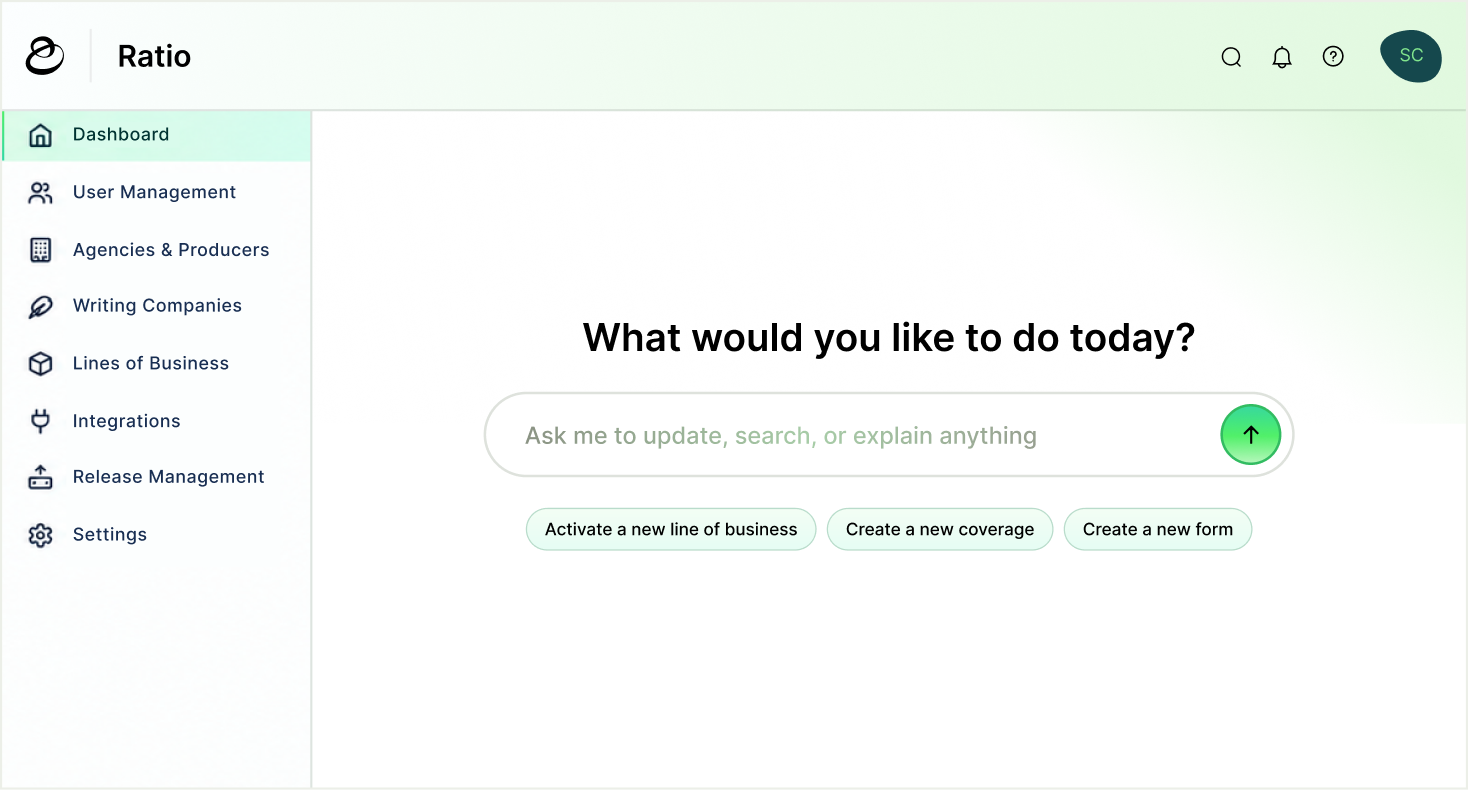
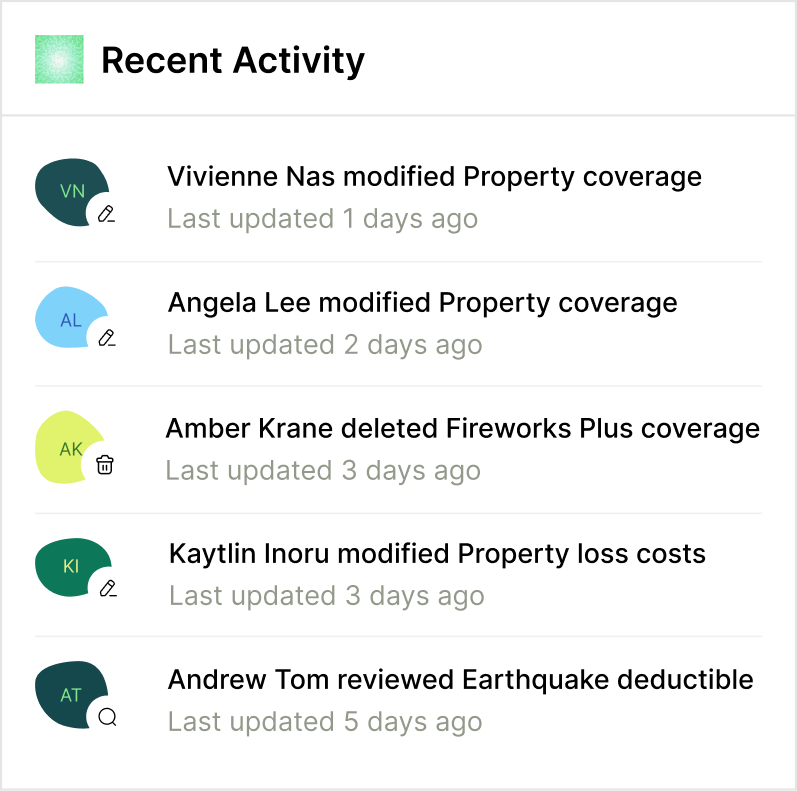
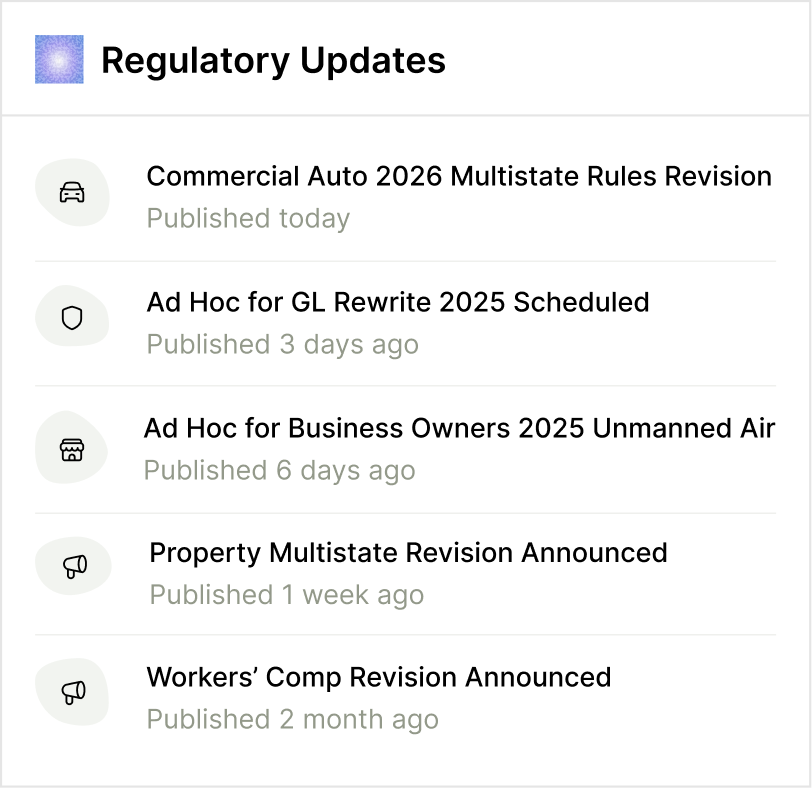

Launch new products in days, not years
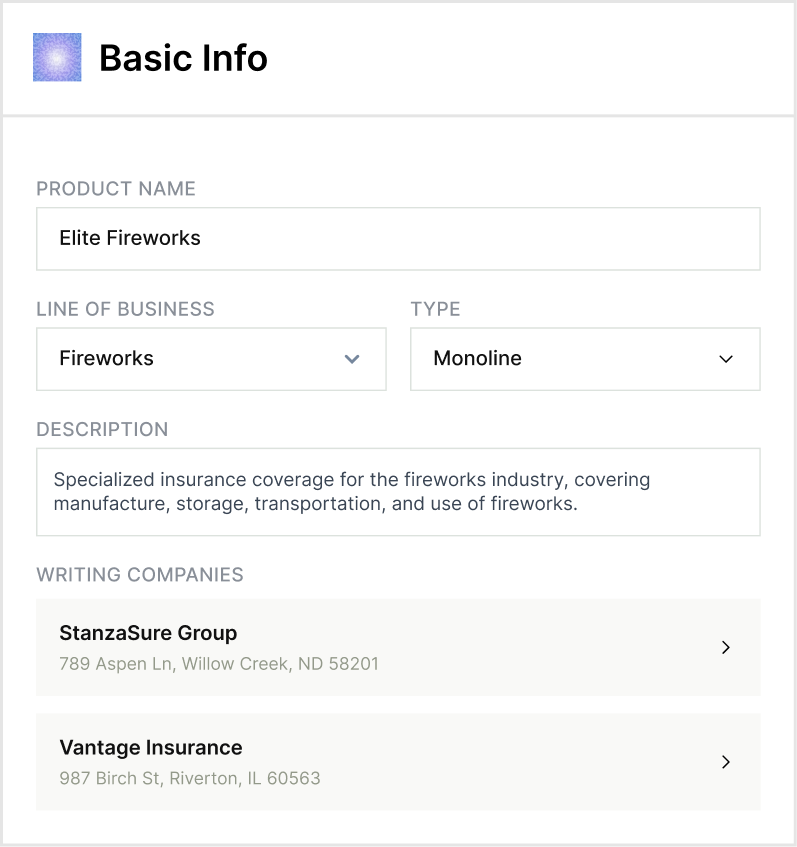
When new opportunities arise, act immediately. No more waiting 18–24+ months to build, test, and launch new products in a legacy system. Ratio Policy AI is built to bring new products to market in days, using AI to help you move from approved idea to validated production change faster, simplifying implementations and allowing you to beat your competitors to market.
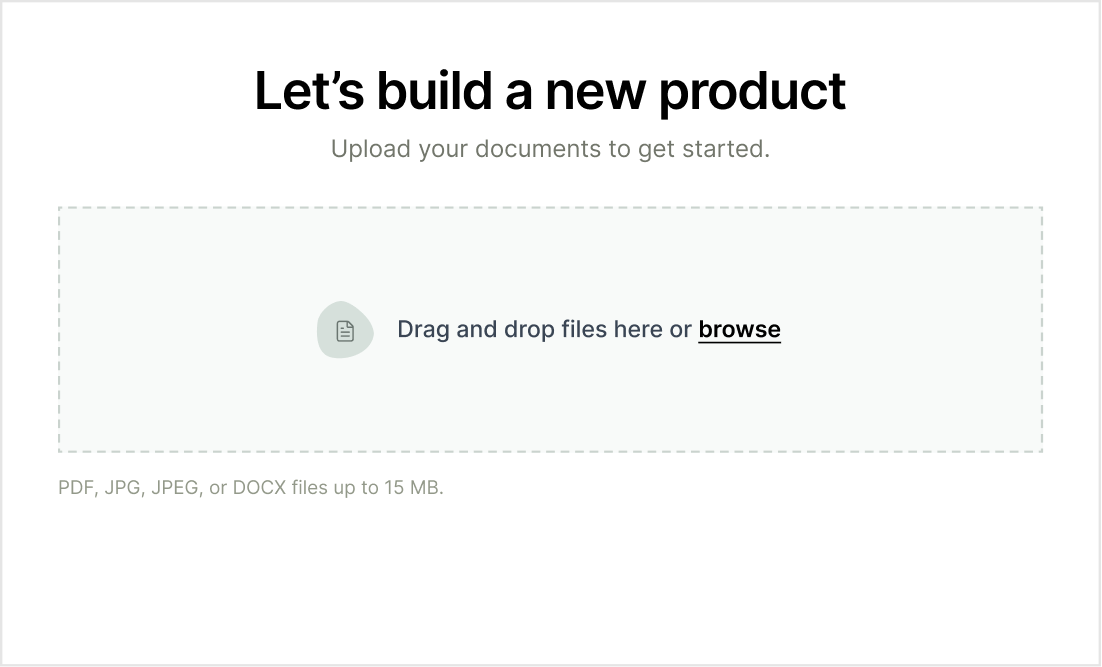
Build from existing insurance content
Start with filings and product documentation, then use AI to draft coverages, states, companies, rates, limits, loss costs, questions, forms, and workflows inside the platform
Validate changes before release
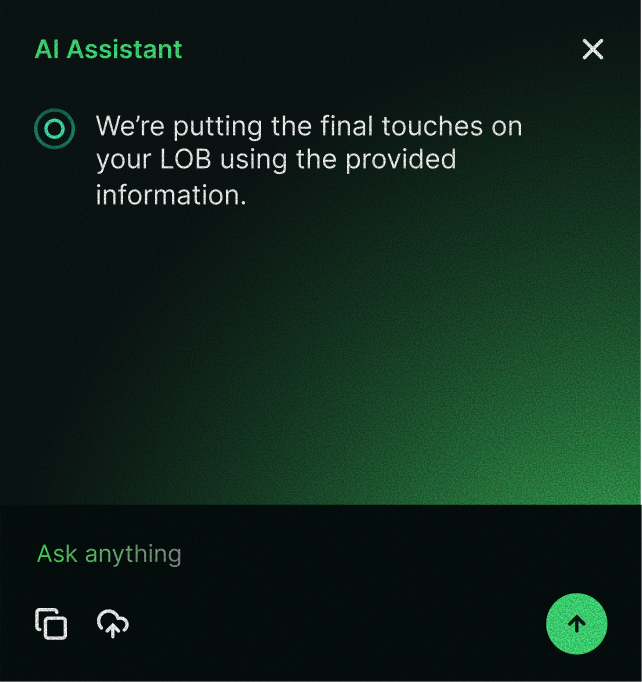
Ratio Policy AI identifies missing dependencies, conflicts, and unintended impacts across rating, rules, forms, and workflows so you can resolve problems before they reach production
Make product changes without waiting
Business users can refine and build configurations directly, reducing custom development, integration reviews, regression cycles, and dependency on system integrators

Rate complex commercial faster than any other system
Rate the full range of commercial business on one high-performance engine. Ratio Policy AI brings the full power of Ratio Content & Rating Engine natively into your policy platform, so you can handle high-volume small commercial business and large, complex schedules without choosing between speed, scale, and commercial-lines sophistication.
Rate high-volume business in milliseconds
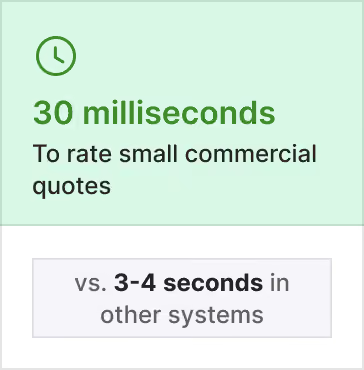
Support fast comparative rating and quote-and-bind experiences for small-commercial GL and BOP, with rating responses in as little as 30 milliseconds
Rate the large policies other systems struggle to handle
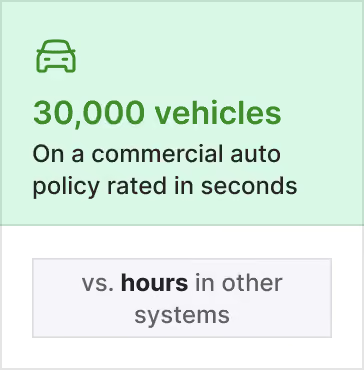
Process large, complex commercial policies with thousands of scheduled items, including commercial auto policies with 30,000+ vehicles, in seconds
Turn rating into a usable policy decision
Apply shared product and rating logic across quoting and policy admin while returning the premium, forms, and stat-code outputs needed to move from indication to bind


Seamlessly maintain bureau content and your unique deviations
Take the bite out of keeping your policy system up to date with the latest bureau content. With Ratio Content & Rating Engine at its core, Ratio Policy AI combines licensed bureau content with a carrier-owned deviation layer, so you can preserve what makes your products different while reducing the repeated interpretation, coding, testing, and maintenance work required every time bureaus publish a change.
Turn regulatory content into production-ready policy logic
Ingest licensed machine-readable content from the bureaus and convert it into rates, rules, forms, and stat-code logic that your policy platform can use
Preserve your unique product decisions
Layer carrier-specific coverages, factors, rules, and deviations over the bureau foundation while preserving effective dates, history, and the relationship between inherited and carrier-owned content
Apply bureau changes once
See which coverages, factors, rules, and deviations are affected by a new bureau release, so carriers can update and validate content and rating logic in one place instead of reinterpreting and rebuilding changes through repeated custom-code cycles

Grow your premium without growing your work, or the cost of your platform
Ratio Policy AI uses AI to handle repeatable insurance work while your underwriters and service teams stay in control of judgment, exceptions, and approvals. Your teams get more capacity to evaluate, quote, underwrite, and service business, more consistent decisions across your book, and a lower expense base that supports improved underwriting performance and combined ratio over time.
Lower your core systems total cost of ownership
Use a configuration-first, modular, API-first architecture with AI-assisted impact analysis, shared insurance context, and governed workflows to reduce custom code, duplicated maintenance, vendor queues, and change costs
Turn more submissions into bound premium
Accept ACORD forms, loss runs, schedules, spreadsheets, and other unstructured materials, convert them into structured exposures and draft quotes, and give underwriters the risk, guidelines, and recommendations they need to respond faster
Make underwriting performance more consistent
Apply shared product, rating, and underwriting rules across teams and transactions while AI surfaces relevant context, referrals, conflicts, and outliers for the underwriter to review, approve, or override

More features
With Ratio Policy AI, you get even more capabilities that make day-to-day operations more efficient and scale with your growth.

Purpose-built for complex commercial lines
AI inside governed insurance workflows
Configure without long development cycles
Built-in regulatory content management
Support policies with
thousands of units
Shared logic across teams and transactions
Connect your own AI agents
API-first, headless capabilities
Less custom code to maintain
Accountability and auditability
at every step
Resources





Book a demo
Ready to see Ratio Policy AI in action? Step inside the solution with a demo tailored to your business priorities.